🎃 Halloween Sale Is On! Save Up to €500 👻 Shop Now
Days
Hours
Mins
Secs

Join Membership for Multiple Benefits:
200 Points for New Signup
Redeem Free Gifts
Member-Only Discount
Radioactive materials are substances that emit ionizing radiation, a form of energy capable of dislodging electrons from atoms present in the atmosphere and water. This radiation can also cause the breakdown of molecules within the human body.
Drinking water for more than 170 million Americans contains radioactive elements at levels that may increase the risk of cancer, according to an EWG analysis of 2010 to 2015 test results from public water systems nationwide.
Radioactive elements find their way into groundwater through natural deposits within the Earth's crust. These elements can become more concentrated when activities like uranium mining or oil and gas drilling disturb the soil, releasing them.
Adding to this concern, in early 2021, Japan announced its plan to release over 1 million tons of contaminated water from the damaged Fukushima nuclear power plant into the Pacific Ocean. On August 24, 2023, amid ongoing debates about this contentious discharge plan, Japan began releasing treated radioactive water from the severely impacted Fukushima nuclear power plant.
While Japan insists that the wastewater, including the radioactive isotope tritium and possibly other elements, won't be a threat, Japanese scientists haven't offered enough proof to ensure harmful elements won't enter the ocean. Neighboring countries and experts differ, suggesting this release might endanger future environments, reaching ecosystems as far as North America. This discharge by Japan raises significant concerns about the safety of our drinking water.
Most pollutants swiftly travel with currents across the Pacific Ocean. A 2021 study estimates the core polluted area will reach North America's coast within about 5 years of the initial release, expanding across the North Pacific and potentially worldwide within a decade. Furthermore, ocean water with radioactive particles can evaporate, forming vapor that contaminates land through rainfall, posing a heightened threat to humanity.
Radioactive contaminants present in Nuclear Wastewater pose a significant threat to human health, wildlife, and the environment. They can make people sick, make the soil inhospitable to plants, and cause mutations in animals.
Here is a more detailed exploration of the potential health effects associated with exposure to radioactive contaminated water.
Reducing radioactive materials in drinking water is of utmost importance. However, these materials can be challenging to eliminate. For instance, the Centers for Disease Control and Prevention (CDC) emphasize that boiling water alone cannot remove radioactive materials. Fortunately, removing harmful radioactive materials from the water you use and drink is attainable. Here are some expert recommendations:
The Environmental Protection Agency (EPA) highlights RO as highly effective in purging water from pollutants. RO membranes, featuring pores as small as 0.0001 microns, enable water molecules to pass while capturing radioactive elements like uranium and radium. This guarantees a supply of cleaner and safer drinking water for your family.
The Environmental Working Group (EWG) acknowledges reverse osmosis as a potentially superior technology for combating uranium-radioactive elements.
Additionally, the Minnesota Department of Health recommends considering home water treatment systems like ion exchange water softeners and reverse osmosis systems to lower radionuclide levels in your water.
An alternative method for removing radioactive materials is ion exchange. Water flows through a resin containing exchangeable ions. These ions form stronger bonds and displace weaker radioactive materials in the water, leaving the radioactive materials in the resin. Radium, a cation (positively charged ion), swaps with other cations like potassium or sodium. Uranium, an anion (negatively charged ion), exchanges with other anions like chloride.
Carbon filtration is also effective in removing radioactive materials from water. Water passes through a filter made of activated carbon. The carbon absorbs and captures radioactive contaminants within the water, contributing to improved water quality.
Each of these technologies is effective in reducing radioactive contaminants from water. You can never remove 100% of radioactive contaminants from water. You can, however, remove more of them if you combine the use of these technologies.
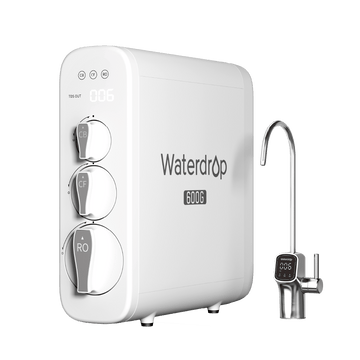
The Waterdrop RO system, for instance, integrates both RO technology and carbon filtration. This combination offers a more potent approach to assist you in efficiently reducing radioactive substances.
| Versandart | Voraussichtliche Lieferzeit | Kosten |
| Standardversand | 3-6 Werktage | Frei |
| Expressversand | 2-5 Werktage | € 5.99 |
Die Versandkosten für Ihre Bestellung werden an der Kasse berechnet und angezeigt.
Die Lieferzeit wird anhand des Versanddatums und nicht des Bestelldatums berechnet. Das tatsächliche Versanddatum kann sich aufgrund einer ungültigen Lieferadresse, Wochenenden/Feiertagen usw. verzögern.
| Versandart | Geschätzte Lieferfrist | Kosten |
| Standard-Versand | 2 bis 4 Werktage | Kostenlos |
| Express-Versand | 1 bis 2 Werktage | €4,99 |
* Die Versandkosten für Ihre Bestellung werden an der Kasse berechnet und angezeigt.
* Die Lieferzeit wird auf der Grundlage des Versanddatums und nicht des Bestelldatums berechnet. Das tatsächliche Versanddatum kann sich aufgrund einer ungültigen Lieferadresse, Wochenenden/Feiertagen usw. ergeben. verzögern.
Wir benötigen 24 bis 48 Stunden, um Ihre Bestellung vorzubereiten. Die meisten Pakete werden innerhalb von 24 Stunden versandt, außer an Wochenenden und Feiertagen.
Sobald Ihre Bestellung versandt wurde, erhalten Sie von uns eine E-Mail mit den Sendungsverfolgungsinformationen. Diese finden Sie auch auf Ihrer Seite „Bestelldetails“.
Das Paket wird von einem unserer DE-Lagerhäuser in Ihrer Nähe versendet.
* Bei Fragen können Sie sich per Live-Chat oder E-Mail an unseren Kundenservice wenden. service@waterdropfilter.com, Wir werden Ihnen so schnell wie möglich antworten!
Die Produkte können nach Malta, Luxemburg, Estland, Griechenland, Kroatien, Lettland, Slowenien, Dänemark, Slowakei, Irland, Finnland, Schweden, Portugal, Ungarn, Belgien, Niederlande, Spanien, Italien, Frankreich, Norwegen, Rumänien, Litauen, Bulgarien, Tschechien, Polen, Österreich, Schweiz, Monaco, Zypern und in die Türkei geliefert werden.
Es tut uns leid, dass wir den internationalen Versandservice momentan nicht anbieten können.
Amazon fungiert als unser Logistikpartner für den Versand von Waterdrop-Produkten. Sie wählen den Versanddienstleister aus, der ihrer Ansicht nach für unsere Kunden am besten geeignet ist.
Hinweis: Anfragen zur Auswahl eines bestimmten Zustellers können wir nicht berücksichtigen.
Falls sich Ihre Bestellung verzögert, kontaktieren Sie uns bitte per E-Mail. service@waterdropfilter.com, Wir werden die Situation zeitnah mit dem Transportunternehmen klären. Vielen Dank für Ihr Verständnis und Ihre Unterstützung.
Kunden des irischen Mobilfunknetzes benötigen einen Netzadapter, um es ordnungsgemäß nutzen zu können. Keine Sorge, wir übernehmen die Kosten.

Fast, Free Shipping
30-Day Price Protection
30-Day Worry-Free Returns
Lifetime Technical Support
24/7 Customer Support
Shop Now, Pay Later 0% APR